I think the one inch sensor that's rumored to come soon to smartphones will definitely push the smartphone to the next level and make the prosumer compacts (like the rx100) finally obsolete.
I don't think the sensor size is the limiting factor on a smartphone; rather the very small lens just doesn't let in enough light to really capture sharp images, especially ones that are far away
Most smartphones lenses are f1.8 to f2.5 which is plenty fast.
The images aren't sharp because the sensor is too damn small, it's more about sensor size than pixel density. That's why a 4x5" sheet of film still blow any digital camera away in term of details, sharpness, tonal range, &c. even when using 80 years old glass in front of it. You realistically can't get more than maybe 12 mega pixels of data from a phone sensor, you can't cheat optic laws by adding pixels.
This is the new 108mpx sensor used on phone, zoom anywhere in the pic and it looks more like a blurry abstract painting than a picture:
>The images aren't sharp because the sensor is too damn small, it's more about sensor size than pixel density. That's why a 4x5" sheet of film still blow any digital camera away in term of details, sharpness, tonal range, &c. even when using 80 years old glass in front of it.
Please demonstrate how it "blows away" any digital camera with a 80 year old lens. This sounds to me like a completely made up claim without any data behind it. (data != one random image)
Modern digital camera sensors are good enough they're somewhat limited by the lenses. So if you have several times the size of a "full frame" digital camera, you can achieve better results with 1940s technology than Sony A7 + 16-35mm wide lens. See this stunning 1942 photo from a large format camera: https://upload.wikimedia.org/wikipedia/commons/2/21/Adams_Th...
>Modern digital camera sensors are good enough they're somewhat limited by the lenses.
In what way? Smartphone sensors have the highest pixel density and they can still resolve an amazing amount of detail through their not-so-great tiny lenses. When it comes to ILCs, everytime there is a bump in sensor resolution, it is entirely possible to extract more detail from the same lens (provided its was a good lens to begin with). And ILCs are still not at the level of pixel density as smartphones, so there is quite a bit of room for improvement.
> So if you have several times the size of a "full frame" digital camera, you can achieve better results with 1940s technology
Not exactly because larger sensors mean larger lenses because of the larger image circle, and then you have a manufacturing challenge of grinding and polishing an even larger amount of glass, so it doesn't scale linearly like that.
That image is very very nice from a compositional standpoint. I respect the work of AA, but I don't feel its rude to point out that it is not particularly sharp by modern standards - the point I assume you were trying to demonstrate? Here's one that even an total rank amateur like me can produce.. which is sharper, with an el-cheapo bargain-bin samyang lens on a non-pro camera body (6d) https://imgur.com/a/l4HBWyi
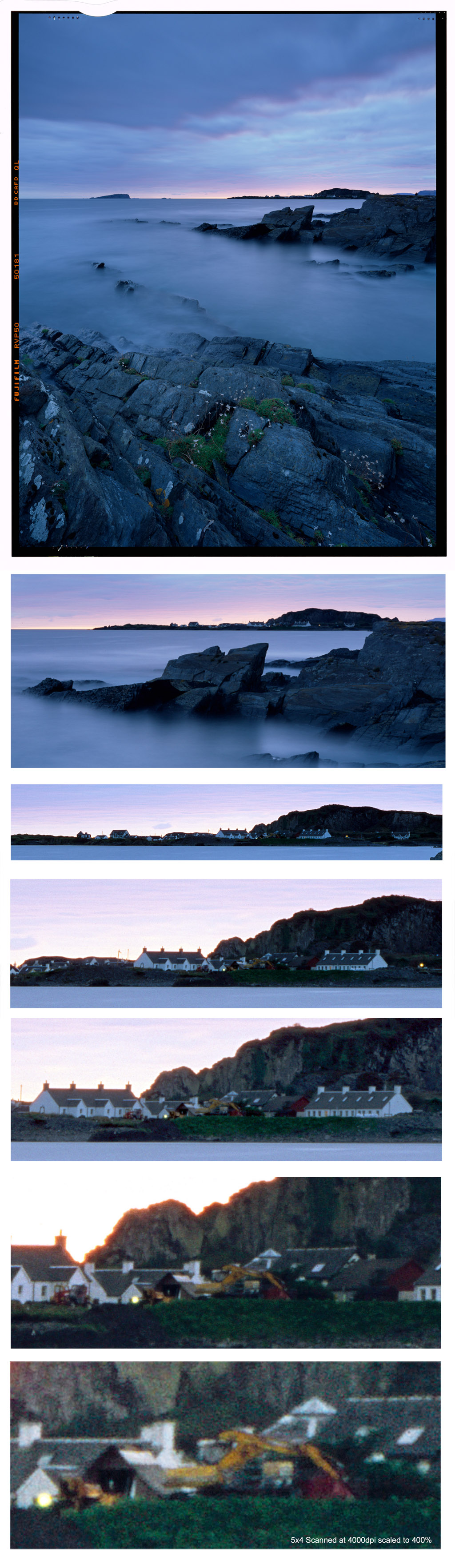
The lenses aren't good enough to resolve details on the new "full frame" 50+ megapixels sensors. The smaller the sensor the more the lens has to resolve. a 4x5" sheet of film is ridiculously big compared to a "full frame" sensor, hence the lens aren't as stressed [0]
> Smartphone sensors have the highest pixel density and they can still resolve an amazing amount of detail through their not-so-great tiny lenses.
No they don't, there are many algorithm tricks to make you think it resolves more details but when you look closely there isn't any details, look at these 64mp samples [1] [2] [3] [4], they don't even look like pictures anymore.
> Not exactly because larger sensors mean larger lenses because of the larger image circle ... larger amount of glass
LF lenses are much simpler than regular lenses, they don't need floating elements, they're not zooms, they don't even need moving parts because you focus through the bellow. There is more glass if you look at the weight, but less glass in term of groups/elements. If anything they're smaller than new "full frame" lenses [5], they only get big if you want something faster than f5.6-4
>The smaller the sensor the more the lens has to resolve. a 4x5" sheet of film is ridiculously big compared to a "full frame" sensor, hence the lens aren't as stressed [0]
I can accept that as a general statement, but it depends on many factors. For e.g. The 4x5 example you linked to was scanned at 4000DPI. 4000 DPI across a 24x36mm sensor gives approximately 20 mega pixels - which is entry level full frame. So its not stressing the lens any more than your LF capture.
Now its true that, at 60+ mega pixels you're doing 6500+DPI, and 240MP (pixel shift) even more so, you're stressing the optics, but we've found that the optics is quite capable of delivering.
>No they don't, there are many algorithm tricks to make you think it resolves more details but when you look closely there isn't any details, look at these 64mp samples [1] [2] [3] [4], they don't even look like pictures anymore.
Those are JPEGS on which noise reduction and sharpening was added by the camera. We'll have to compare RAWs to see the pixel level sharpness.
But again, its not my position that smartphones, which don't have the best lenses, can compete with X,Y or Z format. I'm just pointing out that we're not at the limit of optics, as with every bump in MP we see more details, especially so in professional cameras with professional grade lenses.
>LF lenses are much simpler than regular lenses, they don't need floating elements, they're not zooms, they don't even need moving parts because you focus through the bellow. There is more glass if you look at the weight, but less glass in term of groups/elements. If anything they're smaller than new "full frame" lenses [5], they only get big if you want something faster than f5.6-4
We'll have to do a side by side with the same image to really compare. I don't think you'll come away with LF "blows away" 35mm digital as the poster I responded to claimed.
With a larger sensor, you don't have to compress the image as much, so you can record more detail per unit of area.
If you take two pictures of the same scene, one with a small sensor, and the other with a larger sensor, the geometric difference is apparent.
Scale a 5 meter tree down to the size of a phone's sensor, and you're having to tightly pack the detail of the tree, to something smaller than your fingernail.
But shrink that same tree onto a bigger sensor, or a sheet of 4x5 film, and you don't compress the tree as much.
We don't notice the shortcomings of phone sensors until we try to print the photos. They don't enlarge very well. Printing an 8x10 from a cellphone is challenging, and the grain and imperfections are magnified.
But you can enlarge that piece of film to 8x10 no problem, and the detail is astounding.
If you only look at phone pictures on a phone, then they look very nice, and a piece of 4x5 film is bigger than some phone screens. There are more silver crystals (pixels) in the film than there are pixels in your phone screen, so you can't appreciate the total detail of film on a small phone either.
The thing to consider is choosing the sensor or the film size based on how you want to display the image. Then you pick the best camera for the situation, considering cost, convenience, usability, etc.
I have worked a lot of different analog film cameras and digital ones, and I've noticed that most cameras can take great pictures. You end up paying more for usability and quality. Pro bodies have dedicated buttons and whatnot, so you can accomplish what you need, very quickly.
A touch-screen camera with pure software controls is never going to be for pros, but, cell phones have their moments of better performance for getting the job done.
A cellphone camera is like a piano that plays chords but not individual notes as far as usability. A manual camera lets you do what you want and make up new chords.
Hope that clarifies the image sensor aspect. Aperture helps, but it can never make up for the constraints of the sensor.
> Printing an 8x10 from a cellphone is challenging, and the grain and imperfections are magnified.
Have you verified this personally or seen any data on this? I find this claim very hard to believe. I make several 24x36 prints in a year (albeit from APS-C and FF sensors, but sometimes heavily cropped) and 8x10 is a tiny size that should not present a challenge for any modern cellphone's sensor.
I've used online printing for my cell phone, even pictures from latest iPhones, and they look grainy at 4x6 or 5x7. Maybe it's just a poor printing service. But I spend a lot of time on my computer looking at photos, and the cell phone pics don't look as good. I think some rigorous testing would be a very fun project.
I have been meaning to shoot a roll of ISO 16 film, the CMS20 II by Adox. They claim it can resolve up to 500MP of details.
Would be great to compare to results to full frame with adapted film lens.
Huawei (and probably others) experimented with using multiple cameras to increase light sensitivity. They used monochrome sensors for luminance data along with color sensors. Recently that has fallen out of favor as lenses have improved, bigger apertures have become popular, and sensors themselves have improved, from RGBY sensor in the P30 to various quad-bayer arrangements.