> I am so sick and tired of the copyright laws that play counter to productive creation and stymying efforts to preserve anything. The fact that I have to wait until people die until copyright is up is god awful.
So what's the right way to balance the need to preserve artistic/creative works and the rights of the creator to monitize or permit usage of their works? It seems rather gross to just say that the creator has no right to sell their work or object to some source copying their work and distributing it in a way that deprives the creator of profit.
Various treaties that have been signed and approved prevent that. Copyright longer than 14–28 years is not a bad thing, but copyright for longer than ~50 years is IMO questionable.
I’d love to see some of those treaties renegotiated to limit copyright duration for Works for Hire (e.g., most software out there), but also to reduce the overall length of protection…BUT. I’d also love to see RAND compulsory licensing on copyright materials over a certain age…BUT.
In Europe (not really recognized in the U.S., AIUI), there’s the moral right of the creator in addition to the copyright of the creator. This can be used by an author to prevent their work from being published (say, an author’s private letters that came into a publisher‘s hands) at least while they are alive. I think that’s important.
Nope, there is no such moral right. It’s an artificial right we created (actually mostly taking away the natural right for people to free copy whatever). And then through corruption, ended up expanding to absurdity and locking it in via treaties and all the propaganda that the vast majority of people swallow whole and take it for granted like fish take water for granted.
> the natural right for people to free copy whatever
Practical as it may be, that's not a natural right but merely a physical possibility. More generally, the concept of natural rights - except for a very narrow niche of special subjects closely centered on the individual's own life and bodily autonomy - is a shortcut to total subjectivity at best. And even for that very narrow niche, the "rights" part is a normative civilizational convention/construct, whereas nature conspicuously ignores such "rights" (as do humans for the most part when it comes to other species)
> That’s a fast track to undermining any moral right whatsoever
What is? If you mean the absurd idea of wanting to base those on the murky and subjective notion of "natural" rights, then I fully agree. If on the other hand you mean the reminder that such subjective notions of "natural" rights are a shitty wobbly base for any moral rights (or most other rights as well for that matter) legislation, then no, not at all, quite to the contrary:
The fact of being aware of what rights are (a civilizational norm that grants the individual the protection of their possibilities, as opposed to some inherently subjective notion that a physical possibility would somehow be more special than another because of a subjective view of "god" or "nature") is actually positive for individual autonomy… and a crucial part of enlightenment as far as the legal parts of civilization goes.
In contrast, arguing for concepts based on what they believe to be "natural" is what reactionary forces do in order to restrict individual freedoms. Not so long ago, we had lots of discriminations based on that, e.g. on the idea that black people were "naturally" below white people, that women were "naturally" to obey some role models or that being gay way an abomination against "nature". Arguments based on ideas of "natural rights" have - outside of very narrow special subgect niches directly related to the individual's life and bodily autonomy - always been a major factor against individual freedoms.
Of course that doesn't change the fact that legal systems can also come up with factors restricting individual freedoms based on totally unrelated factors.
> It restricts what you can say or write
so do laws against slander and laws against unconsented divulgation of personal data. Now don't get me wrong, I agree that the domain of copyright does need some reform. But it's clearly not as simple as just to remove everything that somehow restricts (be it copying and sharing of data or other possibilities).
Otherwise any privacy laws and laws for data sovereignty and against unconsented divulgation of personal data would fall as well. They too are based on the legal concept that everyone has an ownership of their data. And more generally, laws about rights are almost always the result of a complex balance to find between the rights and possibilities of many sides.
An idea I’ve always liked is increasing fees over time. Make it renewable in, say, 5 years terms after an initial ten year period. Double the price for each.
So, everything has some prot cation, and valuable stuff can be protected for a long time (at a a cost).
This would seem to strike a good balance… obscure stuff will enter the PD quickly, because the publisher isn’t going to pay even $100 for something they’ve forgotten about, while not kneecapping someone who has a massive breakout success.
Fees that scale on a linear, quadratic, or exponential schedule (or any other above-unity schedule) is a regressive tax. It would disproportionately harm smaller creators. I would run out of money for my IP far before Disney. Unless this scaling was also based on the amount of revenue produced thus far, it wouldn't achieve equitable aims. Even that proposition is dubious since Disney can afford better lawyers to parse the revenue streams to their benefit.
Note that I'm not for the proposition of revenue-based scaling. That would just be a tax on success.
You're presenting a false dichotomy. The alternative to our current system isn't solely "no copyright at all". It's pretty simple: reduce copyright terms to something much more reasonable. I believe the original copyright term in the US was 14 years. I'm sure we can guess why that has been raised several times since then: greedy corporate interests.
Sure, it's certainly debatable what the "correct" term length should be, but I think most people could be convinced to value the commons a bit more and agree that it should be significantly shorter than the current "life of creator + 70 years" (or for works-for-hire, 95 years from publishing or 120 years from creation, whichever comes earlier).
For copyright owned by individuals, why should a creator's children and grandchildren (and great-grandchildren?) be allowed to continue to profit off their ancestor's work, depriving the commons of history and culture? For corporate ownership, why should the company be able to profit for longer than the lifetime of anyone around when it was created or published? Hell, most companies aren't even around that long, so ultimately the copyright ends up being passed to several other companies that have no relation to the original owner.
But really... 14 years sounds reasonable to me. I would even say 25 or 30 years would be ok, if the consensus is that 14 years is too short.
We could also go with a limited renewal system, like is used for patents. Say you get 14 years, and if, after those 14 years, the work is still important to you, you can renew the copyright for another 14 years, or something like that. People and companies who still actively gain economic benefits from their work 14 years later will go to the effort to renew it, but otherwise -- what is probably the majority of cases -- it'll fall into the public domain.
Of course, copyright isn't just governed by US law: the Berne Convention, at least, attempts to govern and harmonize copyright to some extent, and it requires minimums of 50 years after the creators death for most types of copyrightable works. But this is all doable, with political will behind it. As usual, that's always the problem.
>For copyright owned by individuals, why should a creator's children and grandchildren (and great-grandchildren?) be allowed to continue to profit off their ancestor's work, depriving the commons of history and culture?
If the copyrighted works were still relevant enough to the culture that the creator's descendants are still profiting off of the work, I don't see how it could be lost to the commons. If the commons and culture no longer care enough about the work to offer any money for it, I don't see how the descendants could still be profiting from the work.
I don't have a dog in this fight (outside of me bristling at people acting entitled to disregard terms of GPL copylefts), I just what whatever system will optimize the quantity+quality of creative works, and I want creators to get paid adequate value for their work, even if that means they can sell the rights to their work to another entity.
To go to anything less than 50 years after the death of the creator would require leaving the Berne convention and the TRIPS agreement... and the WTO (since the TRIPS agreement is part of the founding set of agreements in for the WTO).
The political will to change that in 164 countries for for the US to leave the WTO would need to be quite substantial.
One would think that this should be in the hands of our elected officials, however historically they have been more sympathetic to the idea that we need longer and stronger copyright than weaker.
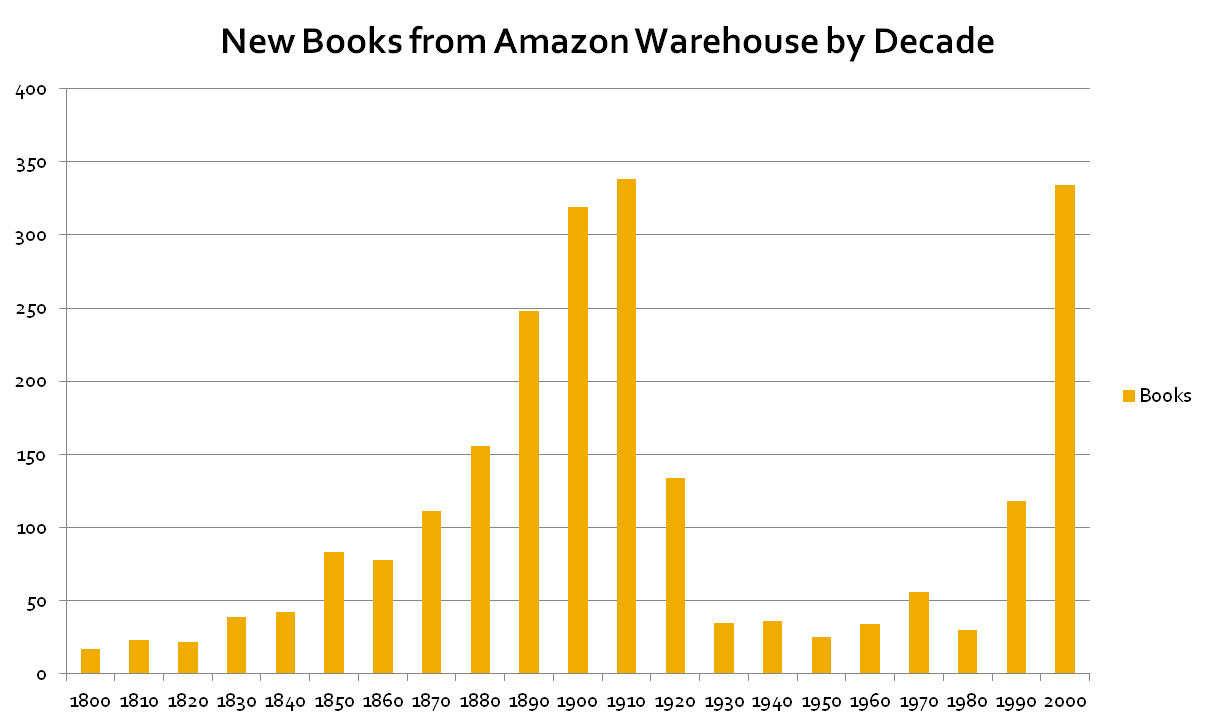
To speak to why we need this sort of thing I would have to harken back to a fun talk that Paul Heald gave back in 2012[0] where he showed this fantastic chart[1] that shows the number of titles for sale on amazon by publish year.
The only thing I can assume from the chart is that either the publishing industry in the mid 1900s suddenly found itself publishing the same amount of books as they did in the 1830, no one cares about the books written between 1920 and 1990, or copyright has caused the loss of an enormous amount culture. According to the chart, and the talk, there are 7 times as many books published in the 1910s than are available from 1930s-1950s.
The entire concept of copyright is problematic - it limits what you can do with property that you own. It's a government granted monopoly.
Ideally copyright would be eliminated and people who choose to create will choose to create. There is development in lots of areas that aren't copyrightable.
If you want to keep copyright, then it should be reduced to the bear minimum to incentivize creative works - that could be on the order of 20 - 30 years.
> The entire concept of copyright is problematic - it limits what you can do with property that you own.
People can own guns. Is it problematic for the government to limit what people can do with their own guns? I would argue that it's not problematic at all, and I bet you would, too.
I'm open to other systems than copyright to make it possible for creators to afford to create and sell their creations. I think Patreon is fantastic, but I don't think it would work well for things like code (or situations where people don't really care about the creator and just want the product).
Everything will have second,third,fourth order effects.
The fundamental problem of intellectual property is that it protects the interests of large corporations far more than those of small creators. IP only matters if you have the resources to defend it in court or if your content isn't worth the effort to steal.
US IP law was written far before the scale of indie digital content or the mere concept of sampling was a blip in lawmakers' eyes.
It was made for broadcasters and publishers to go after industrial scale bootlegging of books and movies.
That sounds more like an implementation/enforcement problem than of the concept of IP.
If [
    1) disputes were decided on the merits and

    2) costs of dispute resolution were

        2.a) deferred until decision-time,

        2.b) born by the decided-against party, and

        2.c) made the decided-for party whole and then some
], I bet either
A) an industry would spring up to identify wronged creators and fund defenses of their IP, or
B) industry would just pay to license the copyrighted work.
TBH I think the tech-bro fantasy of eliminating copyright is a non-starter for the larger business ecosystem. I mean see how long it took us to decide smoking is bad for us. IMO the we can do is incrementally reduce the copyright period length and let the industry adapt around it.
But In my experience once money starts to flow in any entity its much harder to dismantle it without sortof letting bleed out. I dont think disney would give up its claim on the works anytime soon. we need to slay the beast by a thousand cuts.
We don't need to eliminate it, just go back to the original 14 yr term, with a renewal only allowed to the original creator (as an inalienable right so it can't be sold away).
I agree, but your "just" in that sentence is doing a lot of heavy lifting. I think the parent poster describes a more realistic scenario where the term is reduced incrementally over a fairly long time.
If a politician suggested changing the current term (often over 100 years, depending on the details of creation, publication, and ownership) so drastically, they'd be laughed out of office. Or, rather, defunded out of office by their corporate donors.
You return to the original concept of (American) copyright.
Encourage more creative work by exchanging a temporary government granted monopoly now for the promise of it becoming available to society's benefit later.
Current copyright terms are too long. Not everything needs to be monetizable to the nth degree in perpetuity in order for sustainable livelihoods to exist.
> The Berne Convention states that all works except photographic and cinematographic shall be protected for at least 50 years after the author's death, but parties are free to provide longer terms, as the European Union did with the 1993 Directive on harmonising the term of copyright protection.
This is not an American thing.
And the Berne convention was four decades before Disney was founded.
From your article:
> The United States became a party in 1989.
The person you are responding to is writing about American Copyright. https://en.wikipedia.org/wiki/Copyright_law_of_the_United_St.... The first american copyright law is from 1790, which does in fact predate the bern convention, and our life of the author plus 50 years rule is from the copyright act of 1976, 13 years before the US ratified the bern convention.
So yes, it is an 'American thing' as are all issues of law in the US. And if you think that this kind of convention is meaningfully binding, just checkout the history of the US and other major powers with regards to various other international treaties, like the ICC https://en.wikipedia.org/wiki/International_Criminal_Court.
Kinda irrelevant if it's an American thing or not. The US didn't become a party to the Berne Convention treaty until 1989, over 100 years later, but had been increasing copyright terms long before that[0]. We (and others) could just as easily withdraw from it, and make our own rules for works that originate in the US. We could even be nice and honor the copyright terms placed on works that originate in Berne Convention countries.
I think the original terms of American copyright are fine to use as a model: 14 years for all works, period. And certainly that's open for debate; even 25 or 50 years would be much more kind to the commons than what we have now. We could even do like we do for patents, and have a relatively short term, with a one-time renewal option for creators who continue to benefit from a work and still care to keep it protected.
> We could even do like we do for patents, and have a relatively short term, with a one-time renewal option for creators who continue to benefit from a work and still care to keep it protected.
As qyph mentions, I am referencing the American Copyright Act of 1790. It described itself as
"An Act for the encouragement of learning, by securing the copies of maps, Charts, And books, to the authors and proprietors of such copies, during the times therein mentioned."
or, in more modern english
"This is a law that aims to encourage learning by granting authors and owners of maps, charts, and books exclusive rights to their copies for a specified period."
this is important since in developing countries e.g. India, China with regards to DMCA it is commonplace to pirate Americanly-copyrighted media. so much so that it is not even frowned upon. relatively speaking, imagine a choice between paying tensfold what you pay in developed nations vs paying nothing
similarly, for 'freer' countries e.g. France, Sweden, Netherlands - it is very difficult to enforce a law not created by the state whose laws you do obide by
We should be more discerning with where we allow copyright to be enforced. In my view, copyright's only legitimate purpose is to prevent someone else from selling your work as their own in order to make money. If the person or entity distributing your work is doing so with no direct recompense and only has the aim of making the work widely accessible mostly for education, scholarship and to the impoverished who would not otherwise purchase your work, then there should be no case to be tried. You wouldn't make any money off of these uses anyways. The people with enough disposable income to buy your book or software along with dozens of other copyright protected works they may purchase in a year aren't (generally) the same people who spend hours scouring IA or torrent sites for a freebie, their time is worth too much for that when they can just click Buy Now on Amazon and be done with it. Those are the people, whales in gaming industry parlance, that are paying your bills. Fighting legal battles against librarians and pirates won't win you any customers, it'll just reduce your publicity and sour what's left of it.
> The people with enough disposable income to buy your book or software along with dozens of other copyright protected works they may purchase in a year aren't (generally) the same people who spend hours scouring IA or torrent sites for a freebie, their time is worth too much for that when they can just click Buy Now on Amazon and be done with it.
I fully concede that wouldn't go to IA to read any full work (it's too slow and the interface isn't nearly as nice as O'Reilly Online or a physical book), I think copyright made it possible for the current highly-convenient distribution models (of spotify, Amazon, and to a diminishing extent paid video streamers) to develop. In the early 2000s, people who had the money were still extensively using Napster/Kazaa/Limewire/etc to get content because buying an entire CD when you wanted one song sucked (although paying $0.99 for a song on itunes also sucked).
I think there should be a carveout for IA as IA is a uniquely valuable resource, I'm just not sure how to make that into a general rule.
Pretty much everyone I knew who used to torrent music owned very few actual CDs, the few who did own a lot of CDs seemed to only download rare or hard to find tracks and would go on endlessly about the shitty audio quality of downloaded music.
There's a fine line that could exist, but doesn't right now. Archiving content is a concept that goes back to the first cave paintings, and one tactic that has been proposed is to archive silently (meaning don't publish the archive immediately), then publish when the original source is lost. Archive.org did at one point do this, but given how often the internet changes, and the difficulty of tracking published and unpublished content, this eventually went away. We could create a robots.txt-like standard to indicated published and unpublished content, but there is actual money being made by destroying content and siloing everything. Till we accept that destroying history is bad, no attempt to solve this problem will be considered. We can have both, but the people fighting archive.org don't want both.
The "rights of the creator to monitize or permit usage of their works" are only something we as a society grant in order to incentivize more creation. There is nothing that needs to be balanced. The creators also have no "right" to make a profit either.
Capitalism causes some contradictions, this is one of those: you need a complicated/expensive scheme to lawfully defend the rights of content creators because the only possible incentive for producing content is monetary return from selling artificially scarce copies of this content.
In a world where content producers were financed anyway, because we understood as a society that this is valuable, this waste wouldn’t be necessary and we probably would have less “Avengers Nth the movie”. That was the norm and how the likes of Da Vinci and others got to do their work that are now so much appreciated, so I don’t think it’s that utopian.


So what's the right way to balance the need to preserve artistic/creative works and the rights of the creator to monitize or permit usage of their works? It seems rather gross to just say that the creator has no right to sell their work or object to some source copying their work and distributing it in a way that deprives the creator of profit.