I love what the guy is doing. It is a one-man experiment that would be very very hard to reproduce, or even get ethics approval and funding for, by a research lab.
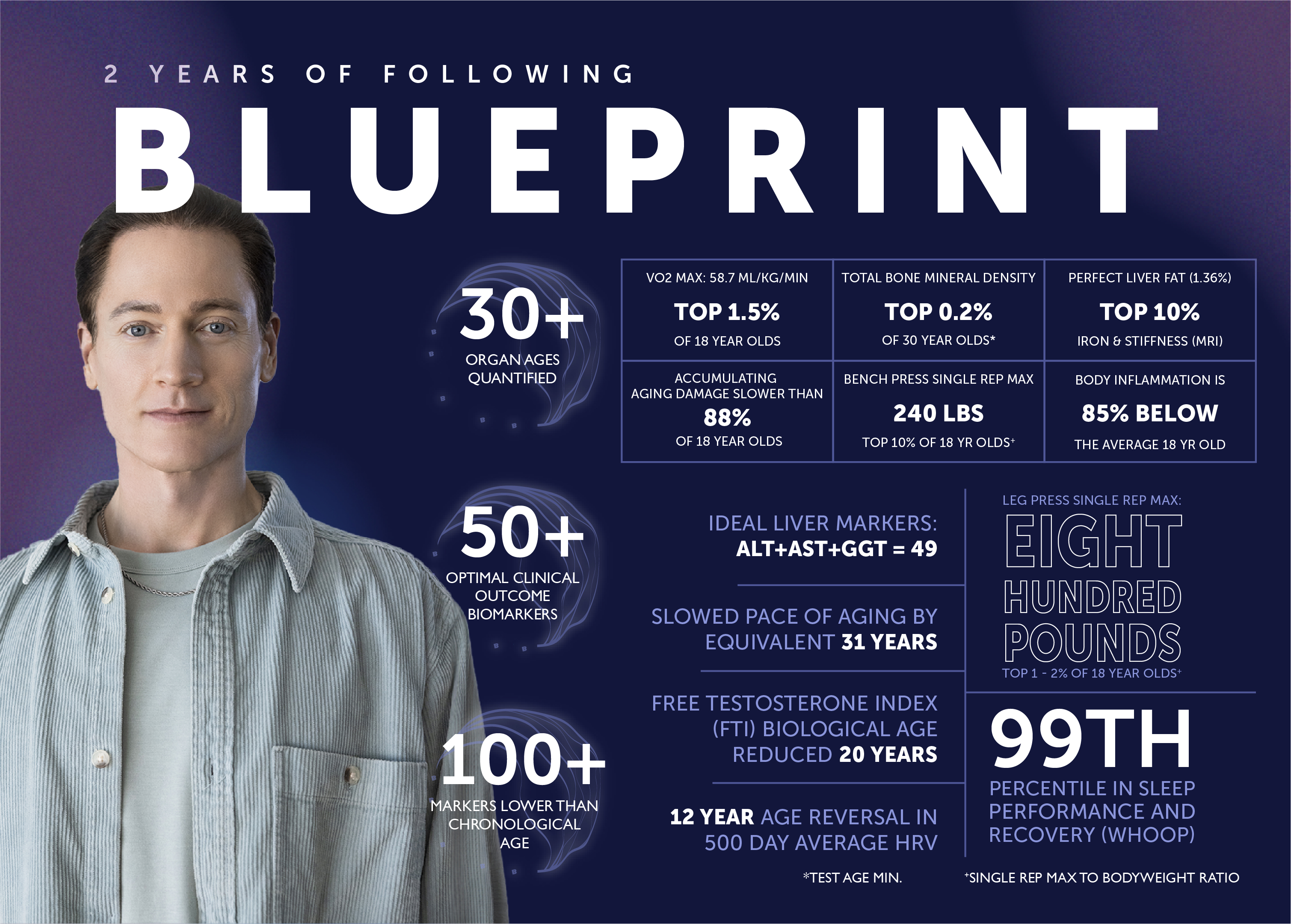
But on the other hand, I get a sense that the public side of his results are overblown. For example, my field is epigenetics, so I had a look at his "epigenetic clock" results. He uses "DunedinPACE" to track the rate of aging and his result is supposedly 0.72 (which very roughly estimates that he ages 0.72 years per a single astronomical year).
However, what is not mentioned, is that this result, while impressive, is not so extraordinary. He is number 6 in his own online leaderboard [1]. And the people who beat him at this metric don't do anything fancy to get better numbers than him [2]. Why not mention things like that along with all the optimism?
He's also made a number of posts, often as replies to people asking the same sort of question that you are, pointing out that 95% of longevity is the simple things we're aware of (diet, exercise, etc.) and that he's just testing out all the other stuff because he can/he's interested/it's a worthwhile investment of time and money for him to get that last 5%.
>However, what is not mentioned, is that this result, while impressive, is not so extraordinary.
The lesson here is that not all phenotypes age at the same rate. Bryan doesn't have a choice in that, like none of us have. He mentions that his hair started falling out in his 30's while I have a full head of hair in my 40's. He's promoting a lifestyle and being an experiment, he doesn't need to caveat his work in any way.
>Why not mention things like that along with all the optimism?
The only people I see with extreme optimism are weird tech people. Most people I follow outside of that circle range from laughing at this to "kinda neat" (like you and me).
Is anyone convinced this is "worth it", or that what he's doing is actually anti-aging anything?
The following protocol will put most people in the top 20% of health outcomes if you're consistent for 2 years. If you're baseline healthy, it'll put you in top 10%. If you keep it up for a lifetime, I'm certain it will add at least a decade of 'high quality years' to your life (I'm not talking life extension, but quality of life).
A good diet (no/minimal processed foods), lots of water, 7.5-8 hours of sleep, limited stress, strong family/social circle, regular (3-5x per week) cardio, (2x per week) strength training, 1x per week high intensity cardio for 30 minutes, and regular stretching/flexibility for 15 minutes per day.
Maybe if he was not doing anything, his score would be 1.1?
Also, I don't think the point is doing fancy things. The people that beat him might just be doing "common sense" healthy things. Something which most people don't do. See SAD (Standard American Diet).
Yeah, of course, maybe it would be 1.1. What I am trying to say is that the results could be reported in a more scientific manner.
For instance, about epigenetic clocks, there are a lot of them now. There is GrimAge for mortality, FitAge for fitness, and dozens of different clocks for chronological age. I cannot know for sure, but I am almost sure Bryan tried at least a few. Why did they select to showcase only this one? Is it because they liked the results the most?
Same for all other markers. All of them are "optimal" "above 95%", etc. Is there no marker that is not so great and can still be improved? Also showing the history of the measurements (how they fluctuate during years Bryan is on the protocol) would be wonderful. Or measuring the same markers for a different person, who is above him in the leaderboard, but not going through the protocol.
I want to repeat that I love what he is doing. But for some reason the website gives a marketing vibe. This is our protocol, everything is optimal, here is our olive oil. Which is a bit of a weird look, given the lengths Bryan Johnson is going through.
"Maybe" isn't exactly scientific; what he should've done was keep his existing lifestyle, have the same measurements taken, but not actually look at them because they would influence the measurements.
Without a baseline, the numbers are meaningless. What if most people are under 1 but there's a few outliers that skew the numbers?
Thought this section would be helpful to highlight:
  > If you’d like to stop this insanity...:identify the worst version of yourself.

  > For me, it was 7pm Bryan who would eat everything in sight to try and momentarily escape life pain. He is a monster, overpowering, and indifferent about all other Bryans needs. A sweet talker and expert rationalizer.  7pm Bryan ruins life quality for all other Bryans:

  > - awful sleep

  > - overweight

  > - poor health

  > - accelerated aging & disease

  > - turbulent emotions

  > - depressing life outlook

  > The solution: revoking 7pm Bryan’s authority to eat food.

  > Now your turn:

  > - Step 1: identify your 20% rascal..

  > - Step 2: list what decisions they are and are not authorized to make

  > - Step 3: wait for them to appear

  > - Step 4: approve or deny their requests using step 2 list

  > - Step 5: celebrate happy you for stopping self harm.

  > Believe it or not, this is your most consequential and powerful life intervention.
There is a very weird lack of interest in slowing down or reversing aging in the scientific/medical community in general. To me it seems like it should be a top priority. Life is extremely short and extending our lives shouldn't be a terribly hard feat given there are plenty of biologically immortal and long lived organisms all over our planet.
We have so much lower hanging fruit to tackle first that doesn’t even require research: what’s the point in extending your miserable life a couple more miserable years? Adding a decade on to your life of extreme privilege is worthwhile, but for the majority of people on earth, simply getting them on to a nutritious diet would do far more for their quality of life and their lifespan than slowing down aging ever could. So much human suffering is a result of policy, not lack of scientific understanding.
Slowing down aging is like going to space: it’s a fun complicated problem for nerds to think about but it is utterly meaningless to the quality of 99% of lives on earth.
> Slowing down aging is like going to space: it’s a fun complicated problem for nerds to think about but it is utterly meaningless to the quality of 99% of lives on earth.
Except that aging is the causative factor behind Alzheimer's, Parkinson's, cancer, AMD, and a battery of other illnesses
They're illnesses for which age is the biggest contributing factor of whether you'll get sick, and how sick you'll get. Nearly every disease affects you more severely the older you are.
There is no sharp line between "slowing down aging" and common-sense things like diet, sleep, exercise, etc. It all exists on the same spectrum.
>simply getting them on to a nutritious diet would do far more for their quality of life and their lifespan than slowing down aging ever could.
That in itself is a scientific claim that needs to be supported by evidence. How are we going to get that evidence if we aren't doing the research? We also don't have a good definition of exactly what a "nutritious diet" is. The idea that we shouldn't be be investing in health and longevity research is anti-intellectual and short-sighted, in my opinion.
So you think we should extend humans life so they can spend more hours on the couch eating junk food?
30% of the worlds population is currently 'severly food insecure' (starving) [1].
Dont you think the priority first should be sorting out enough food for the existing population? When 100% of the world is fed properly and well, and we have surplus food, then maybe extending life should be come a scientific priority.
I'm not sure why you would infer from my post that I'm not in favor of solving world hunger or that I'm encouraging people to have unhealthy diets. My point is that figuring out how to solve food scarcity is a scientific problem, as is figuring out how to improve people's diets. Eating a healthier diet slows down the aging process and increases lifespan. There isn't a sharp distinction between the two problems, and we can make progress in both. The idea that we shouldn't be doing scientific research on one area until all problems are solved in another, especially when the areas are related, is deeply mistaken.
There are dozens of essential nutrients. You only need about 15% of your calories to come from protein. Protein = health is laughably simplistic and incomplete. Also, the only reason we know what protein is is because we did the scientific research in the first place.
> Lifespan and metabolic health are influenced by dietary nutrients. Recent studies show that a reduced protein intake or low-protein/high-carbohydrate diet plays a critical role in longevity/metabolic health. Additionally, specific amino acids (AAs), including methionine or branched-chain AAs (BCAAs), are associated with the regulation of lifespan/ageing and metabolism through multiple mechanisms. Therefore, methionine or BCAAs restriction may lead to the benefits on longevity/metabolic health. Moreover, epidemiological studies show that a high intake of animal protein, particularly red meat, which contains high levels of methionine and BCAAs, may be related to the promotion of age-related diseases.
You're choosing to pick the negatives but the potential upsides (even excluding personal desires) are monumentally massive.
How about not having 25% of the population walking around with an underdeveloped pre-frontal cortex at any one time, that need 30 years of education before they have the wisdom to do anything halfway useful. How about government policies that operate with a decades long view instead of just one election term. Global ID's would rise massively and decisions would have a far more balanced outlook.
Yes of course there are positives. Don't worry, we have never let negative consequences hold back progress before.
But the blind optimism is staggering, and let's get philosophical: what's the ultimate good, objectively? (Subjectively obviously _I_ and _you_ think it's that we get to be around for longer.) But objectively, from a humanity standpoint, is it (1) the most people in existence, (2) the most people to ever have existed, (3) the most consciousness, (4) the most happiness? Etc.
If we start letting people live forever, over a long time, because of resources, fewer people will ultimately exist. We'll also have slower progress because old ideas will live longer. It's very hubristic to think we've peaked, and it's inevitable that the first live-forever generation will put the brakes on progress/change.
I'd say those downsides far outweigh the upsides you've proposed.
There are many people who completely healed it with a drastic dietary change: going low carb, going full carnivore, going vegan, eliminating junk food.
Still doesn't say anything about what causes heartburn. Why did they have make drastic changes when they were fine eating carbs before heartburn? Why doesn't that work for everyone? How long did this relief last for ppl it works for?
Life doesn't seem short. Heck, humans are some of the longest lived mammals in the world. I suspect people only say life is short because they are counting the days ahead of them and comparing it to the days behind them - not considering the total number of days. I bet very few 10-year-olds would say life is short, but maybe a lot of 60-year-olds would.
Treating illnesses, diseases and injuries should have higher priority, as they impact QOL and mortality much more. Once almost everyone gets to age 80 in health, then we can tackle extending the life span.
Extending our lives should definitely not be a priority. We already have enough trouble on the horizon with resources on earth provided for an exponentially exploding population. The only thing keeping this in check currently is the elderly dying from disease and old age. If we reverse the aging process, or cure cancer or something similar, this planet will very quickly become a very horrible place to live.
Yeah I'm not really sure what to think about him. He gives off serious grifter vibes and at least some of his claims are probably overblown. On the other hand, who is he hurting? He's "experimenting" on himself and making the results available for everyone. He'll sell you some of the stuff he does but the details of his entire regimen are also freely given away for anyone who wants to do it themselves. He's an unusual person for sure.
I really wish he did his research without being restricted to a vegan diet. He mentioned in one of his videos that his choice for a vegan diet isn't motivated by health, so I can't help but think that part of these recommendations are just there to mitigate the effects of that specific diet. For example, an omnivorous diet might not need certain supplements.
I am glad he is focusing on a vegan diet (especially if no technological revolutions are made in artificially derived animal products). It's nice to learn about the downsides of it in order deal with them rather than just defaulting back to animal products.
One of his main points in the intro is not destroying our biosphere and going vegan is the single most impactful thing an individual can do to support that. Supplementing B12 is not that hard of a task to ask from a population which already swallows pills and powders by the kilograms a year.
Why so? A vegan diet when supplemented is an easy way to avoid potential bad consequences of animal products, such as heart disease, cancer, obesity or diabetes.
The only real thing that meat-eaters do not have to supplement that vegans do is b12 (because livestock are supplemented with it) and maybe omega 3.
This directly contradicts the Wikipedia article on the subject [1], and in general the page you link looks more like pseudoscience than not. Do you have a better source, maybe from a published paper or the NIH?
Presumably referring to this sentence from the Wikipedia page you linked to, quote: "Marginal deficiency is much more common and may occur in up to 40% of Western populations.".
If the vegan diet was one of the outcomes from his experiments (where the goal is to optimize for anti-aging), I'd be fine with it. But it's a restriction he put on himself based on a ethical/philosophical motivation.
I'm not deeply familiar with all the things he tried, but from what I understand, he tried many different changes in nutrition and lifestyle. He also attempts to optimize his sleep schedule and exercise plan for his goal of slowing down/reversing aging.
Nutrition is a very big component of his plan/blueprint and excluding a very big chunk of the search space (animal based foods) doesn't give me as much confidence that he found an optimal or close to optimal plan (especially compared to the effort required) to achieve his goal.
Livestock is given B12 supplements. B12 only occurs naturally in soil, where the concentrations are too low for even animals to bind. Prehistoric humans probably ate more dirt and had enough of it.
Sure, here you go: eating cobalt from the soil wouldn't give you B12, because bacterial fermentation in humans is occurring in the colon, while B12 is absorbed by the ileum.
But actually there's a solution for vegans. As the following paper in Nature eloquently puts it:
"Human faeces contain appreciable quantities of vitamin B12 or vitamin B12-like material presumably produced by bacteria in the colon, but this is unavailable to the non-coprophagic individual."
And maybe omega-3? That’s underplaying the role of long chain PUFAs by a lot.
And when you say annual products, are you talking about all animal products, like seafood? Because there is a vast difference between oysters, muscles, and salmon, and industrial farm raised beef.
And animal products, again, are you excluding the organ meats, which are extremely high in many things that could possibly extend our lifespan? Like riboflavin, manganese, zinc,?
I wish blueprint was more public and open about the methodology and data. Johnson is doing so many interventions and it would be interesting to have public data for them beyond a periodic aggregate snapshot on the blueprint websites which basically amounts to a marketing page. In comparison someone like Michael Lustgarten (1) publishes nearly everything, documents what intervention they are about to do, do it, and then publish the results.
I think i've mentioned this here before, but a friend of mine (Andrew Steele) is an anti-aging biologist, and has written a book on the subject. He's an excellent communicator, and a while ago did a video examining Bryan Johnson's claims: https://www.youtube.com/watch?v=7rs_JK-pTTQ
Umm isn't that the point of trying to reverse aging ..to look normally youthful not look so unusual that the look isn't youthful at all just unusual. Look at all the comments here that agree some saying the look is that of a vampire. Thats what the majority thinks and wishes for when it comes to reverse aging ..to be and look 20 again yet with all the wisdom and wealth gained over the years.
Just to keep the sarcasm going: Is there a scientific test that checks for "looking like a vampire"?. Cause he sure does to me, but I'm not a vampire-specialist, so what do I know...
I think he looks old and young at the same time. It's obvious he is not 20 years of age. But he doesn't look like 44 either. It's almost like he looks much younger than his age giving him this unnatural look.
Since very few people are measured and as fit as he is, it's not strange that we think he looks strange. But mostly I think it's lightning and makeup giving him this unnatural look.
The thing is that what "looks" healthy is culture-dependent; nowadays in the caucasian west, looking lean and tanned is considered a healthy / attractive look, but in other places, times and subcultures having more weight or pale skin is considered healthy (or attractive).
That doesn't prevent it from correlate. If obesity is the bigger threat than looking skinny is correlated with being healthy. If food scarcity is a bigger threat than the opposite.
However a lot of more subtle things like soft, shiny hair or good skin are correlated with nutrition.
Was thinking like maybe he has cancer or something cause he doesn't look healthy ..maybe the truth is is that his diet really is about keeping him alive & trying to find a cure for what he has naturally.
This is only a thought and an opinion based on how I think he looks which looks not healthy to me, but again only an opinion. Time will tell!
I cant tell if you're being sarcastic but the protocol was developed as the result of his teams reading the latest published literature. I'm not being snarky here but if you have a problem with it, it's the result (by definition) of you not being up to date on what the corpus of science is telling us about nutrition.
His protocol was developed as a result of his team trying anything and everything that might potentially help. "The definition of what the corpus of science is telling us about nutrition" is overselling it. There's a reason the site is plastered with "this is not medical advice" disclaimers.
> + 31 year age reversal in grey hair age (80% reduction in grey hair)
I'd be a lot more interested in this if I still had hair. But what's surprising is that the man I see in all the pictures and videos like one linked in another comment [1] clearly dies his hair. That's a very interesting choice for a someone who appears to be naturally blond based on the childhood photos in the video, and with 80% reduction in grey hair.
Also:
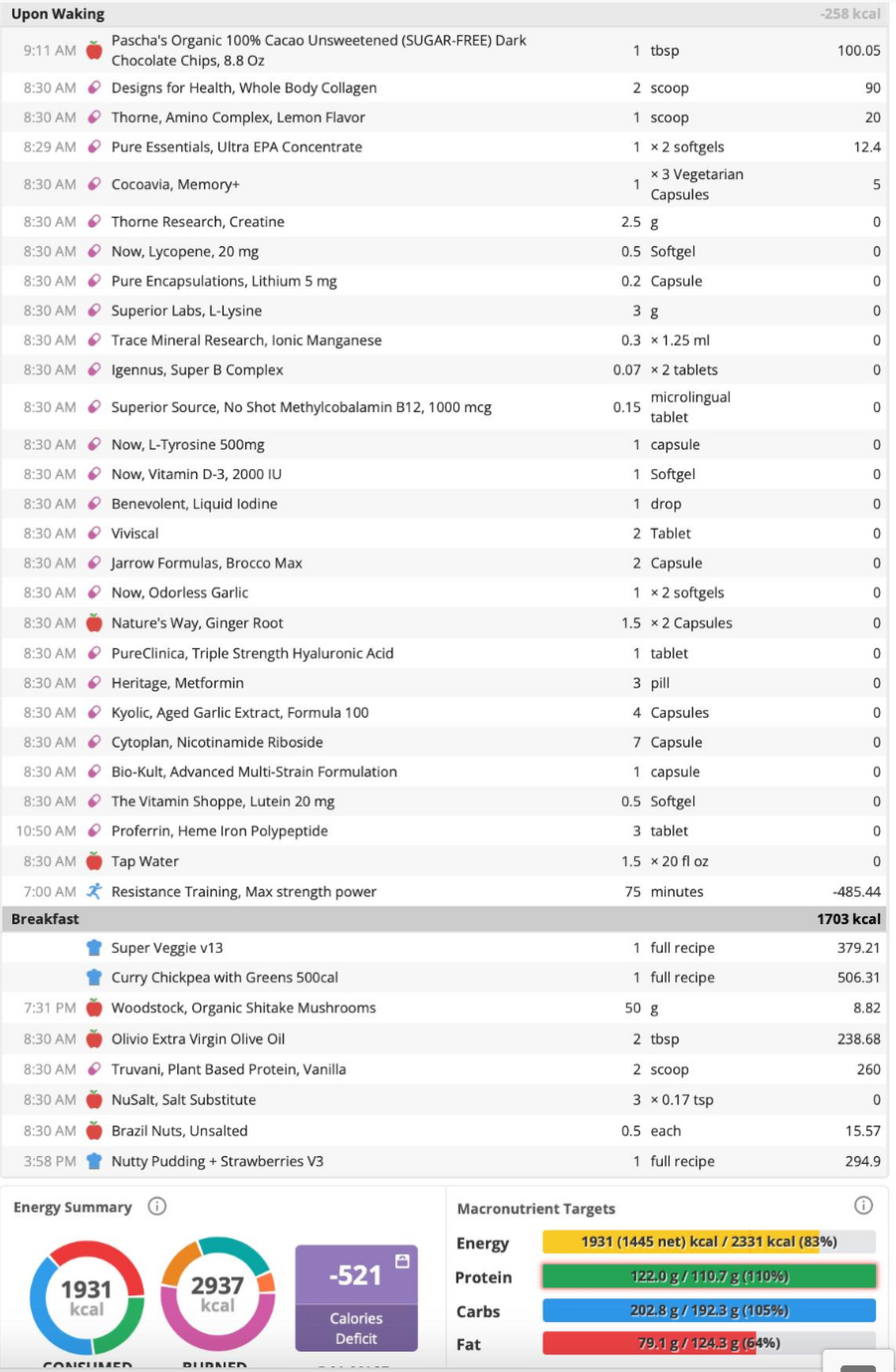
> Monthly Blueprint cost = $1,684.50
Being healthy was never easier if you're rich enough to afford the healthy lifestyle (it may be a lot cheaper than $1.6k/mo but still expensive). It's good that we know what it takes to be healthy but if it can only be available to a few than it won't bring a health revolution.
Maybe the guy is overdoing it (obviously). On the other hand, it seems that he put a lot of research into optimal nutrition. So would consider the meals pretty solid.
It appears he has some brain markers such as white matter hyper intensities and ventricular volume that are older than his age of 46.
The Blueprint health protocol may end up giving people with healthy bodies but an aging brain, so they will be able to live many years with dementia (because the body is otherwise healthy).
Whether having a healthy body with dementia is worth spending all this money and effort for is an interesting question.
To be fair, Bryan started Blueprint just a couple years ago as an overworked, overweight 40-something. Damage done.
What remains to be seen, is how his brain markers develop 5-10 years down the road. I'm not sure he can reverse aging in many areas. But slow it down noticeably? Sure.
> The Blueprint health protocol may end up giving people with healthy bodies but an aging brain, so they will be able to live many years with dementia (because the body is otherwise healthy).
Your brain being damaged by dementia will absolutely ruin your body in a very short amount of time. In the late stages your brain can no longer perform involuntary functions and you would literally need to be fed by IV and on a respirator to stay alive.
the goal shouldn’t be to avoid death but to live our old age in adequately healthy and strong bodies (proportional to age and our daily routines) and a sharp mind still capable of following complex arguments. i doubt the strategy for this involves all this sacrifice and masochism. but fear of death is such an overriding fear. it commits us into slavery and makes us do crazy things with sufficient justification. life’s for living not longevity. so live! tecumseh’s poem comes to mind:
So live your life that the fear of death can never enter your heart. Trouble no one about their religion; respect others in their view, and demand that they respect yours. Love your life, perfect your life, beautify all things in your life. Seek to make your life long and its purpose in the service of your people. Prepare a noble death song for the day when you go over the great divide. Always give a word or a sign of salute when meeting or passing a friend, even a stranger, when in a lonely place. Show respect to all people and bow to none. When you arise in the morning, give thanks for the food and for the joy of living. If you see no reason for giving thanks, the fault lies only in yourself. Abuse no one and nothing, for abuse turns the wise ones to fools and robs the spirit of its vision. When it comes your time to die, be not like those whose hearts are filled with fear of death, so that when their time comes they weep and pray for a little more time to live their lives over again in a different way. Sing your death song and die like a hero going home.
The first thing that comes to my mind upon seeing something like this is how well will he handle aging and deterioration.
My extreme prejucide is he is indeed obsessed with his health. Human health sometimes is not about the bad things we get? but how well do we handle those curve balls.
I kind of fail to see how would this be useful for anyone but him. The fact that he has a team working with him to make him the most healthy human possible is cool and all, but there is absolutely 0 guarantee that what works for him would work for any one else.
Our bodies can be surprisingly different, this is why it can be surprisingly hard to draw any conclusion from research involving a few hundreds tests subject. As an example, a lot of diets are still contentious and the subject of many debate.
So with one data point ... For all we know, his Blueprint might be over-optimize for his own body and might be extremely detrimental to most people.
Although, on a side note, seeing how my grand parent fared towards the end of their life, I did realize that I do not fear death or aging, I fear the slow withering where you get more and more diminished. So I get where this idea is coming from
I think it makes sense. He's doing the most extreme things to find things that work. And then be able to say, "This subset of intervention worked very well, let's try to reproduce it in a larger population."
Seems a lot more extreme then that (e.g. he doesn't just tell people to sleep better he also tells people to buy special bed sheets with silver in them to ensure your bed is electrically grounded), and it seems likely he gets kickbacks from some of these products.
Can you link me to a statement where he actually tells people to buy sheets with silver in them?
Honestly, I've followed him for quite a while and pretty much all of his content is wholesome and while a bit culty, it's not like he is forcing anyone to do anything. For the stuff that actually makes him money, he is a lot less sales-pushy than the overwhelming majority of youtubers. You can get his protocol for free and follow as much as you want to, buy the supplements and silver sheets from wherever if you want to.
In the section "Blueprint Protocol Starter Guide" he lists it under stuff he uses ("grounding sheets").
He doesn't explicitly say to buy it (and in fine print says its not an endorsement) but clearly the links are there to encourage people to buy these products.
I dont know if he's getting a cut but half the products getting promoted have discount codes which is suggestive.
> it's not like he is forcing anyone to do anything
Snake-oil salesmen generally don't.
> he is a lot less sales-pushy than the overwhelming majority of youtubers.
Generally it is counter productive to be super pushy. It raises people's guard and makes them less likely to buy.
Oh wow. So he has an affiliate link, which he doesn't push anywhere except on his website. Such a criminal behavior.
> Snake-oil salesmen generally don't.
Dude. Snake-oil doesn't do shit for you while if you follow the blueprint protocol maybe you won't live longer but the probability increases (by being healthy).
What I am saying is it's fine to make money of something you have spent so much time in researching and building. Who cares? He's giving out most of the advice, diet etc etc for free. Sure you will be able to buy some products in the future but you don't have to. It doesn't mean that lots of the advice is good advice for your health.
I just don't understand the phenomena of hating on a guy that is super wholesome, tells people to be more healthy and live longer.
From my perspective, it seems like he is manipulating vulnerable people who are terrified of death into wasting money on products that are at best unlikely to help and at worst might be harmful to a person's health for his own financial benefit. Some of the advice potentially being beneficial doesn't change that.
I find this about as wholesome as the Nigerian prince who intends to give me part of his fortune out of the goodness of his heart.
That's an appeal to emotion and / or straw man; nobody is against telling people to sleep more / exercise more / eat better. Anyone can say that, it's not unique. What else is this fellow saying / advocating? What are his motivations? Is there a catch? Is he selling or promoting something?
> nobody is against telling people to sleep more / exercise more / eat better
Actually, I am not so sure. People today are effing insane, especially on the internet.
His motivations are as clear as a blue sky to me. He is building a company, the company will make money by selling products like meal replacements or good olive oil (maybe other things in the future, who knows). But in general that is probably just a way around the problem of financing the whole ordeal since he is obsessed with health and trying to figure out the optimal way to live in order to age the best way possible.
Most diet studies are just as good or bad as his because the issue with diets is that there can be so many factors playing in so it's hard to know if it's the diet or other factors weighing in. He is just trying stuff with the help of doctors and dieticians (and probably others as well) and I applaud that. Maybe things work for him that will also work for the majority of people, in fact I think it is likely.
Sure it is culty, but you kind of have to be in order to be able to live like he does. It's an extreme form of living and not for everyone but I think most people today can learn a lot from him by simply doing some of the things he does.
Today we live in a world where many countries have like 50% of the population being fat and many are even obese. If you go to any store in many western countries at least they are optimized for you to pick candy and sugar water at the end. It's hard to find healthy products in many cases, you have to read the label on basically everything. If you go on a road trip, pretty much the only restaurants by the roads are fast food that is super bad for you. It is HARD to be healthy today and the statistics clearly shows it. So much so that in my country at least many clothing stores have started to display fat models in commercials because people (mostly women) demands it. We also have mukbangs on youtube, super obese people spreading their crap online but the one that gets a lot of hate is a guy that tells people to be more healthy. That is the insane part to me.
He is also personally experimenting with things far more extreme than that. Like off-label pharmaceuticals, replacing his blood with blood from his son, and even gene therapy.
Well yeah, but he doesn't say people should follow him but rather that everyone are free and should make changes to his "protocol" in order to make it fit their life.
> Personally, I'm against using my children as blood banks
C'mon dude. Stop the hate and grow up.
If my father called me today and asked for my blood in order to live longer I would gladly help him. I want my father to be healthy and live as long as possible. Besides giving blood is not bad for you, it can even have positive health effects that several studies have shown.
You also have to assume that the blood giving is consensual since there is no reason to assume otherwise.
I am really surprised of the amount of people on hacker news, what I consider to be an increcibly intelligent community, actively defending or advocating what this guy is doing!
I love his scientific approach to health and I find his transformation inspiring but the costs of following his protocol is probably in the hundreds if not thousands every day.
Even if it does 100% work as advertised, the amount of details to follow in the protocol is insane. Half of the things there are probably placebo, the other half can be condensed into the less complicated solution.
I've seen some of Bryan Johnson's work... will keep an eye on it as he seems a lot like Tim Ferris where he experiments on his own health and shares the results!
Bryan Johnson is already independently wealthy, and if he wanted to become even wealthier there would be much easier and more lucrative options.
The most parsimonious explanation for his behavior is that he very genuinely does not want to die.
Of course, anyone who is rich and famous is liable to veer into narcissism and abuse of power.
But if any HN reader were very serious about doing whatever it takes to live as long as possible, then reading this page would be a great start, as it is one of the most obsessively researched and documented health regimens towards this goal.
Honestly it sounds like he is putting a lot of stress on himself and I'm not sure that helps to stay young at all. He doesn't look young but at least he dresses younger which I guess is something.
Bryan Johnson is going all in, because (1) he wants to show what's possible and (2) he can afford it. He's dedicated his entire being to the cause. You and I don't need to. What we should do instead, is learn new and interesting stuff from his journey, and apply the 80/20 rule.
He’s thin and stays out of the sun to reduce damage to the skin. Makes sense that he looks different than most people because of these two things alone.
He does say he’s hungry all of the time. Not sure if I would get used to that.
It's counterintuitive; people need sunlight to generate vitamin D, but it also causes cancer. People in both the middle-east and the north are often vit-D deficient because of a lack of sunlight exposure, in the north because there not being a lot of sunlight, in the warm/dry climates because they dress and live for the weather which means not a lot of skin is exposed.
I get that the metric dictating this is probably "avoid skin damage", but surely the health benefits of, say, 15 minutes of sun exposure dramatically overweighs the risk of skin cancer.
There's a suggestion that the senescent effects of skin aging have a systemic effect. Anti senescents or senescent modulators might counter such an effect and allow the positive benefits of sun with fewer negatives.
I know I’m going to get downvoted for going against the crowd, but as a biochemist my impression here is that there’s at least as much pseudoscience as there is science.
Also, if you know more than others, that's great, but in that case it would be better to share some of what you know, so the rest of us can learn. Simply posting a putdown doesn't do that.
Sometimes it takes an enormous amount of effort to put years and years of expertise down in writing. I’m sorry but here it’s just not feasible, it would require pages and I don’t think it would do much to persuade anyone here.
> If you're going to say something on HN, please make it substantive.
I believe calling out pseudoscience as such is substantive. To be perfectly clear, I think not doing it would even be irresponsible. Also, substantiveness does not always require great detail, under most common usages of the term that I know of.
> This applies to scientists the same as any other commenters.
Sorry, (and I promise it's nothing personal!) but just using the putdown "pseudoscience" is not enough to make a comment substantive. This is just standard HN moderation, and it's not a borderline call. Generally speaking if what you're doing can be described as "calling out", it's probably better to just not post it to HN anyhow. That's not the curious conversation we're looking for.
For the comment to count as substantive you have to explain something about why, and then you don't need the putdown part. People are slinging pejoratives and tropes like "pseudoscience" all over the internet. Adding "I'm a scientist" doesn't overcome this; besides which of course, anybody can say "I"m a" anything.
Ok, but the problem is that the term is an internet cliché and people are going to interpret it in the way it's commonly used, even if you don't intend it as a putdown.
We have to moderate by effects, not intent. No one can know your intent but effects are observable, they're what matter (because they're what affect the site), and you're responsible for them. (I don't mean you personally, of course; I mean all commenters.) Because of this, the burden is on the commenter to disambiguate. This is also standard HN moderation btw: https://hn.algolia.com/?dateRange=all&page=0&prefix=true&que...
I feel like we've drifted a bit, which is largely my fault, but the basic point is that when I look at https://news.ycombinator.com/item?id=38841126 - it's not a borderline case. That kind of comment isn't ok here.
As someone training more in CS/stats, without formal bio training, can you point out the main items of pseudoscience?
Seems like he's doing the classic "management" tactic of setting targets, measuring progress, and coming up with models to best represent/simplify complex systems.
You really think he’s going through all this effort to sell supplements?
The community found what is likely the source of the olive oil, and surprise, it’s being sold at just about cost.
He created a team and measured his biomarkers, then came up with a strategy to improve them. That’s what blueprint is. You likely shouldn’t copy him, as you are not him, but some of the things, like improving sleep, exercising, improving nutrition, can be followed by many.
He’s just a rich dude focused on improving his health. It’s nice he’s publicly documenting his results, but it’s not expected for you to follow everything.
He's smart enough to understand that while these interventions might help, they're realistically only going to add a decade or two to his life. And the stuff he's doing is fairly intensive – it's not like he's just changed his diet or something. Going to such extremes for an extra decade isn't affordable and likely not even worth it for most people who want to balance enjoyment with longevity.
I don't get the claim he's doing this for science either because even if he lives a couple of extra decades (say to 100) it would be difficult to claim that his interventions did anything at all given no trends can be made from a single data point. And the bulk of any longevity gains is probably going to come from simple interventions like exercise and diet.
So I think you have to be cynical... I think you have to assume he's taking an extreme approach to gain some notoriety within the growing anti-aging community and is trying to leverage that for self-promotion and profit.
I mean, why is he being so public about this stuff anyway? The guy has a YouTube channel where he talks about all the things he's trying so it's not like this is simply something he is personally interested in and occasionally writing about. He's clearly making his self-experimentation a business and clearly wants people to follow his journey. For example, this isn't simply information, this is marketing material likely designed to be shared on social media, https://freight.cargo.site/t/original/i/0128a596fea8b3a19e55...
I'm not hating though... I think it's kinda cool what he's doing honestly, but it's hard to not see this as a play for fame or clever marketing for a wellness / supplement business.
He just looks like a 50-years old guy who spends a lot of time in the gym/kitchen. His face and skin texture give away its age.
I have no idea about his health protocol, but I'm pretty sure a regular healthy life style (avoiding junk food + recommended dose of exercising) would give you the same results in term of longevity.
1. there seems to be a consensus about what a generally healthy life style is (see health organizations guideline), but no evidence that dosing the right vitamins and vegetables is going to make a significant difference. In that regards, this guy is basically experimenting some recipe on himself.
2. just by experience, we've all seen huge variation of life expectancy around us, some people die at 95, other at 75, and lifestyle didn't seem to be the only factor. There's so much randomness with genes, social relations, accidents.. that we'll never know whether his protocol provides any benefit
IMHO, this guy is just a snake oil salesman, and it works because of an illusion of control bias.
So if you devote an inordinate amount of time and money on longevity, you can know what it feels like to be a 45 year old man in a 42.5 year old's body
I don’t understand this pervasive fear of death in the tech community. Yes, one day we are all going to die. Yes, one day the human civilization itself is going to die. The entire universe will die too. So what? We all knew this from the age of five or so.
I don’t want to die today, and tomorrow I’m not going to want to die, and the day after I’m not going to want to die, and so on. Therefore, I want to live forever — proof by induction on the natural numbers.
I liked the song I'm listening to 1 minute in. I liked it 2 minutes in. Therefore, I want to listen to this song forever -- proof by induction on the natural numbers.
And I want to become a billionaire tomorrow. Except there is some actual very small probability of me becoming a billionaire, but I am nearly absolutely certain that one day I am going to die (save for some miracle-grade event). This worries me about as much as the fact that the sun will rise tomorrow.
We all agree it would be bad to die at 40 if you could have lived to 60. By that logic, isn't it bad to die at 80 when you could have lived to 100? If you could do something to increase that probability, wouldn't that be a good thing? Good health also increases quality of life, independent of whether it extends lifespan.
To put it another way, pre-civilization life expectancy was somewhere around 30 years. Would it have been wise to say to someone who was trying to live to 60, "So what? We all knew we're going to die from the age of five or so. This is pointless."
I agree that sometimes these health protocols are excessive, and can be driven by fear of death, among other things. It's also uncertain how many years on average any given habit will add, and there are opportunity costs that need to be factored in. At the same time, I see this common knee-jerk response to dismiss any attempt to extend human life. Given the abysmal state of health of the average person, I think it's a good thing that some people are working on figuring out what contributes to optimal health.
> To put it another way, pre-civilization life expectancy was somewhere around 30 years.
You probably mean life expectancy at birth. The birth and childhood were pretty tough, but if you lived to adulthood, life expectancy was just a bit smaller.
I think the point still stands. In the Paleolithic era, life expectancy for the 60% reaching age 15 averaged 39 remaining years [1], so you could have expected to live into your mid 50s, compared to mid 80s today in developed countries [2]. That's a 30 year difference, so it's more than "a bit smaller".
Immortality has been the pursuit of people with fuck you money and/or fuck you power since time immemorial, as they don’t have much to worry about otherwise and have the resources to do wacky shit. The rest of us mostly don’t really care much about it. Nothing special about “the tech community” here.
>Human body is an inelegant and unoptimized vehicle for intelligence.
Why do you think so? the impermanence of it? the gradual performance decrease? the biological/physical limitations that constraint it?


But on the other hand, I get a sense that the public side of his results are overblown. For example, my field is epigenetics, so I had a look at his "epigenetic clock" results. He uses "DunedinPACE" to track the rate of aging and his result is supposedly 0.72 (which very roughly estimates that he ages 0.72 years per a single astronomical year).
However, what is not mentioned, is that this result, while impressive, is not so extraordinary. He is number 6 in his own online leaderboard [1]. And the people who beat him at this metric don't do anything fancy to get better numbers than him [2]. Why not mention things like that along with all the optimism?
[1]: https://rejuvenationolympics.com/leaderboard/#absolute
[2]: https://fortune.com/well/2023/11/04/longevity-women-biohacke...