If anyone is curious to learn more about the history of plants, electricity and signaling, I’d recommend reading up what Jagdish Chandra Bose researched on (https://en.m.wikipedia.org/wiki/Jagadish_Chandra_Bose). I don’t have a specific recommendation for any specific work and I’m open to recommendations.
Fun fact, JC Bose was a teacher of Satyendra Nath Bose (the boson/Bose-Einstein condensate guy).
> Soil microbes interact with plant roots to generate low voltage. Specific electrodes planted in the soil convert the voltage into a low current that acts as a stimulus for plant growth by boosting metabolic processes, including photosynthesis.
> Seedlings were grown in 3 kg pots, filled with the mixture of red soil, sand and treated with fungicide for inhibiting the fungal infections
It would be very interesting to take the next step and try this in different soil types especially what would generally be considered as 'better' or 'more normal' (say no-til farming with rich soil-life, balanced amounts of minerals, etc - not 'red soil mixed with sand'). Just thinking out loud, but it might be possible that this 'convert the voltage into a low current' actually happens in such less sterile soil type automatically because it already has anodes and cathodes.
This could also be very interesting in hydroponics, though often the issue there is too much root growth. Tomato especially. They love to clog up all the pipes and starve everything else.
Once upon a time I had a hobby growing mushrooms of various types. One day I tried an experiment; I placed little bags populated with oyster mushrooms at various distances from my Wi-Fi hub, a bag about each 15cm or so. After the expected grow time, I had successful growth at the farthest distance of perhaps 2m. However, up close to the base station, all of the bags within 1m or so showed no growth whatsoever. Most notably, there was no contamination, no mold that was visible, and none of the desired oyster mushroom growth. All the bags within one meter were basically sterilized.
So there is certainly a way to say "do not grow". If anyone works out the opposite encoding, I am sure there will be a lot of interested parties who would like to speed up their growth processes.
A huge thousand meter apple tree powered by a nuclear reactor that keeps saying grow more, single handedly producing the country's yearly apple intake.
I had a similar thought, something like varying levels of ambient humidity closer to the washroom. The experiment needs to be repeated in more controlled conditions. Surprised to see the HN crowd taking this obvious pseudoscience at face value.
No, experimenting is not pseudoscience, but taking a single flawed experiment communicated anecdotally with no mention of setup or control and then moving into discussion about the "results" as if it was performed in any way reproducibly is pseudoscience. It presents itself as science but when you pick it apart it's actually lacking many mainstays of what we'd call scientific methodology.
Calling for more rigorous experimentation is not a dismissal of experimentation. It's healthy to be critical about experimental methodologies and to call for more rigour before conclusions are drawn.
There have been several experiments that have showed similar findings, and I looked through half a dozen or so and didn’t find any that showed otherwise. Here’s one that you can browse:
Reminds me of a story I heard about a microwave (?) Link on a rural hill somewhere in NZ that requires switching off when techs go to site because it transmits over the road. Cows have to be fenced out of the area in front of it because it damages them, but no grass grows in a cone infront of it anyway.
Can't remember if a uni mate told me that or John Sullivan the telecoms lead of the Auckland skytower construction.
There is a Swiss startup which is doing something like this. They have created a plant sensor that taps into the electrical signals of plants, and use AI to develop an understanding of plant communication. The use case seems to be early diagnosis of stress rather than manipulation of plants, but who knows some day the same understanding can be used to 'control' plants: https://vivent.ch/
We already throw like 1/3rd of what we grow, and most of it is a fraction of the quality it used to be. I don't think making more of that faster is a problem to solve
I think we've already cracked the code on intra-plant communication for growth which is conducted by hormones like Indole-3-acetic acid and the other auxins. I guess it isn't impossible that manipulation of action potentials could augment this.
That's due to increased carbon dioxide uptake. Essentially you're feeding the plant too much carbon dioxide, so the end result is unbalanced production of starches/sugars.
Tomatoes are a good example of where we select for surprising goals. Tomatoes sell best when they're very red so we breed them to be red at the expense of both flavour and nutrition.
Cannabis as well, it's selected to smell strong, since people make their purchases based on sniff tests, at the expense of the quality of the high.
except the demand for good tasting tomatoes would be sooo high I can't believe it's just Big Tomato screwing us. It's hardly a secret that garden grown or in season farmstand tomatoes are so much better than what we get in stores.
I read about the "gene for better flavor also leaves green around the stem" a long long time ago, long enough that those tomatoes would be in supermarkets if it were that simple.
Readily available so-called heirloom tomatoes explore all sorts of colors and gradients, and they sell well, and still they aren't that good. Gotta be more to this story.
tomatoes tend to lose flavour and texture if refigerated. but refrigeration tends to extend shelf life.
The other factor is that tomatoes that ripen on the vine tend to be tastier than tomatoes ripened off the vine. However fully ripe tomatoes tend to be squishier and don't travel as well. So they tend to be picked while firm and ripened using ethylene gas. These tend to be less tasty but easier to transport and store.
It's tradeoffs. A farmers market will typically have tastier tomatoes, when they are in season, than a supermarket, because they are picked when ripe, transported a short distance and sold within days. but if you're eating tomatoes out of season then expect them to be picked while unripe, refrigerated and then ripened off the vine so they can even make it to the supermarket shelves
If I'm standing in the shop looking at different tomatoes I have no idea how any of them taste. The only information I have is their country of origin and their physical appearance.
If I've never read about trends in tomato genetics, presumably like most people, I'm just going to figure that the juiciest tastiest ones are the big red ones.
I assume the answer is pretty simple: many people shop on a budget, and spending more on better tomatoes isn’t often included. Thus we end up with producers lowering cost instead of raising quality. The consumers who do spend more are already served by the existing markets.
It isn't just selection for being red, but other market characteristics that are at the expense of taste. Suitably thick skin, shelf life, uniform size, bruise resistance, and for production disease resistance and yield per unit area in production setting.
Then, they get picked green for an even longer shelf life, and gassed with ethylene to turn red before sale. That definitely is not good for flavour.
But if you are in a temperate climate, people expect a consistent product through the year so that is what a supply chain that can deliver red oblong fruit steadily through the winter at a cheap price yields. Supermarkets probably also prefer dealing with suppliers that can provide a steady stream rather than periodic gluts at harvest time, so picking green and storing fruit probably allows them to be trickled onto market.
A vine ripened tomato is soft and either needs to get to market and sold much quicker or there will be considerably more wastage.
Heirlooms in stores are always a smaller section than the 2-3 varieties of uniform red ones (now there is the 'on the vine' gimmick where they sell clusters, which were still picked green), and generally 3-4x the price. They still probably get picked early and may be refrigerated in the supply chain so you aren't getting the same thing as you would growing it yourself.
I would disagree that the demand for good tasting tomatoes is they would outcompete the crap red ones. Here, in season local 'field tomatoes' (which are picked a little early but not green so show up in the store reddish, slightly less uniform in shape) and in terms of everything but colour and presentation are superior, but are the same or cheaper in price, it's not like the bullshit tomatoes disappear in season.
I can only speak for my experience in Europe, but as far as I know the biggest selection bias in tomatoes is breeding them to be resistant to bruises when transported. And that only appplies to the ones exported to countries where it's not easy to grow them.
On top of that they're often picked before they are firm red (because they are more firm), with the knowledge that they will turn red over time after picking anyway.
On the other hand, I'll never forget the one time a Dutch colleague went on a trip to Italy, and when I asked him afterward how it was all the talked about was one time he went to the market and bought and ate a fresh tomato there, with just a pinch of added salt, as if it was a religious experience.
"You don't understand, it was like I ate a real tomato for the first time in my life! A real tomato, vanderZwan!"
Your colleague should search for some local markets selling such tomatoes; in summer obviously, otherwise they aren't available. Not claiming they are the exact same breed as the ones in Italy nor exactly as tasty, but the difference with the imported and/or hydroculture (or whatever it is these days) off-season ones is huge.
Another interesting broadleaf herbicide mechanism is overloading invasive plants with chelated iron. Broadleaf weeds absorb iron rapidly and without regulation until the point of toxicity, whereas grasses will only absorb what they need to turn a nice healthy dark shade of green.
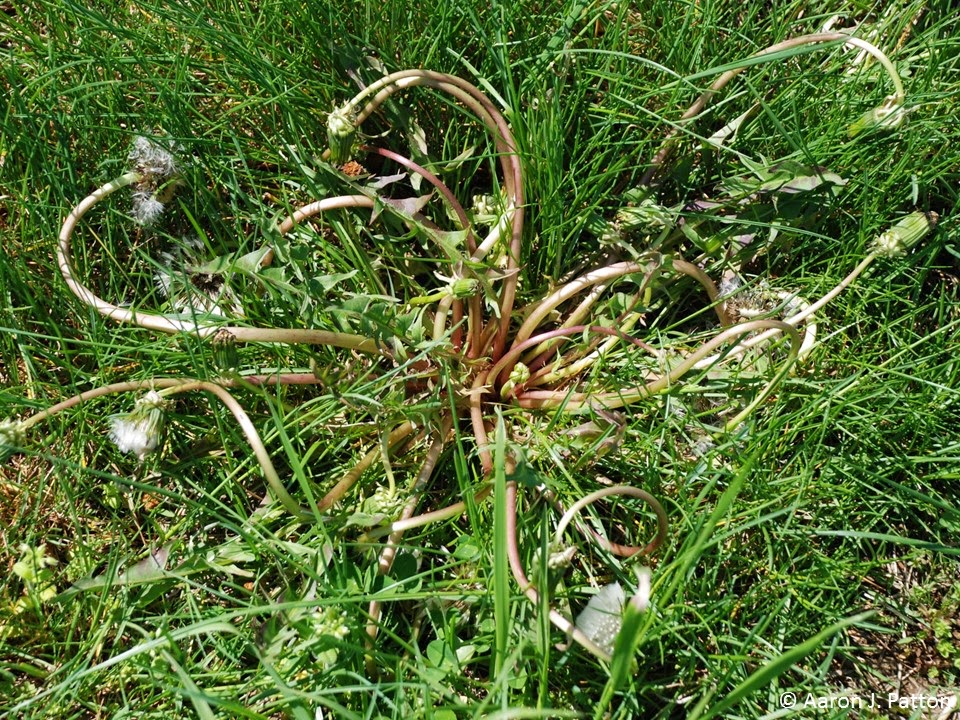
That image makes me appreciate just how slowly most plants grow and move. Imagining that bundle of dandelions writhing around triggers the same sort of visceral reaction as seeing maggots for me.
If it’s any consolation that picture was probably about a week after treatment, so still quite slow! The entire process takes about two weeks depending on the type of plant.
in general growth is a coordinated process and pulling on one single lever hard is not going to be good. But there are times when encouraging growth is desirable, like using plant growth hormone (synthetic auxin) to encourage a cutting to produce roots or a plant to grow a new branch in one location.
I'd really like to know if they did a control where they heated the soil around the roots with the same amount of power using a heating mat or something. My bet is that it's the heating that is inducing the changes.
I wondered about electrode material too. But both questions remain unanswered because sci-hub hasn't added new articles since the 2020 attack in on them in Indian courts. I have no way to access the full text to make an informed comment. The only detail in the snippets and abstract was that it was 50mA of current. That'd be about a watt of heating for typical hundreds of ohms volume resistances of damp soil.
The open circuit and control having a similar effect show that it likely isn't ions from the anode or cathode.
The other two are more interesting- presuming the short circuit had a lower effect than the one with some resistive load (labelled closed circuit), I presume there's something changing in the soil chemistry itself once sufficient potential is reached by microbe activity. Ions being knocked loose from the dirt itself, rather than the anode or cathode, which wouldn't happen when there's a direct short / no load other than the wire.
I don’t have access to the full paper, but this doesn’t follow:
> The open circuit and control having a similar effect show that it likely isn't ions from the anode or cathode.
When you apply current between two electrodes in an electrolyte, you do a few things:
1. Create an electric field between them.
2. Create an ionic current through bulk electrolyte.
3. Cause chemical reactions at the surfaces. This has to happen: the current in the electrode is made up of electrons (or, equivalently, holes), but the electrolyte doesn’t conduct electrons — it conducts ions. [0]. So, for charge balance to be maintained, every electron that exits the anode into the medium needs to somehow turn into an ion, which happens by chemically adding an electron to something, thus reducing it. Similarly, the cathode pulls electrons from the electrolyte, and they come from something in the electrolyte, which is oxidized as it loses the electrons.
If the cathode in particular is not inert at the voltage used, the cathode itself can be oxidized. A copper cathode can, for example, produce copper ions much faster than it it would naturally leach them without an applied voltage.
[0] I’m sure that exceptions exist. Solvated electrons are a thing. And you could use an electrically conductive substance as your medium, e.g. carbon or metal powder.
Yeah, seems like they would need to use gold or platinum electrodes to rule out copper (or whatever) leaching. But even if it's copper leaching that boosts growth, that seems interesting in and of itself---just not really due to electric current.
"Another finding was that levels of proline – a stress metabolite in roots and leaves – shot up. This suggests that the electrical stimulus could enhance the plants’ capacity for tolerating stress."
"A diet rich in proline was linked to an increased risk of depression in humans in a study from 2022 that was tested on a limited pre-clinical trial on humans and primarily in other organisms." https://en.wikipedia.org/wiki/Proline
The most plausible explanation from this thread IMO is that plants use the potential difference between the earth and the air to measure their height. Placing a conductor in the soil means the potential difference in the air around the top of that conductor is the same as the soil, so plants determine they are shorter than they should be and need to grow more.
I'm not 100% convinced, as from my gardening experience a lot of plants will grow as tall as they can with unlimited space and resources (tomatoes are a great example of this). However maybe it's not the above ground growth that is affected. Bigger root systems give access to more reasources so maybe it is the same mechanism there.
I wonder if it's really just something super simple like, sound waves vibrate and loosen the soil making it easier for the roots to grow deeper and thus get more nutrients.
Paper isn't on scihub, but I wonder if the authors paid any attention to electrons vs protons in the "current": In most biological systems electric charge is a property of (mostly positive, metal) ion concentration gradients which are managed quite selectively (e.g. a cell might have high interior/low exterior potassium and also high exterior/low interior sodium)
And an electric current through the dirt near roots is a flow of cations near the roots
So I'm wondering if they controlled for mass transfer - Maybe some of it is just making mass transfer of something in/out of the root vicinity less of a rate limiting step
Well I thought so as well. But the problem is in order to ground yourself you have to touch a probe which is buried deep in the ground. Barely walking on grass with bare feet doesn't ground you I have heard. YMMV
I've seen a TikTok where someone talked about using a low voltage in their garden to boost plant growth. I thought it was silly and one of those fake 'boost your productivity' videos. I guess it turns out to be true!
I dont think you read the abstract. Theyre adding probes and a resistor to the soil. Theyre not putting current into the soil. The current is generated by microbes in the soil.


Fun fact, JC Bose was a teacher of Satyendra Nath Bose (the boson/Bose-Einstein condensate guy).